On April 3, 2025, Benjamin Netanyahu landed in Budapest. An ICC arrest warrant had existed for him since November 21, 2024, issued by the International Criminal Court's Pre-Trial Chamber for war crimes and crimes against humanity committed in Gaza. Hungary is a state party to the Rome Statute. Under Article 86 of that statute, member states are legally required to cooperate with the court's arrest procedures. Viktor Orbán, Hungary's prime minister then, gave Netanyahu a red carpet reception at Buda Castle and announced during the visit that Hungary would withdraw from the ICC entirely. The court, in response, referred Hungary to its Assembly of States Parties. The Assembly noted the finding. Nothing changed. Netanyahu returned home.
This sequence — warrant issued, warrant ignored, state withdraws from court, court issues a finding, finding produces nothing — is not the story of a system breaking down. It is the story of a system functioning precisely as its architects designed it to function. The International Criminal Court was built to look universal. It was never built to be universal. The distinction is everything, and Israeli actions in Palestine have made it impossible to look away from.
The Nuremberg Paradox is this: the framework of universal justice was born from the Holocaust. It was demanded by survivors who had watched the world do nothing while their people were systematically destroyed. They built it for everyone. And now a Jewish state sits beyond its reach, and the court can do nothing but write reports about countries that refuse to cooperate.
That is not a failure. That is the design.
What Nuremberg Actually Was
It is worth being precise about what the Nuremberg Tribunal of 1945 was and what it was not, because the mythology has by now almost entirely displaced the history.
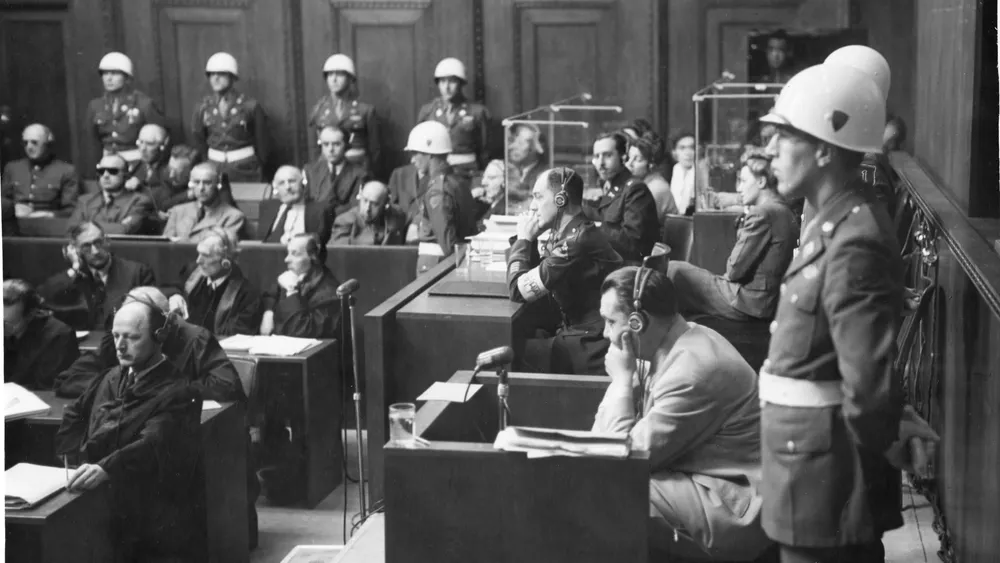
The Nuremberg Charter was signed by four states: the United States, France, the United Kingdom and the Soviet Union. It created a tribunal to try the leaders of a defeated enemy. The Allies could convene this tribunal because they had won the war. They could compel the appearance of the accused because Germany had surrendered unconditionally. The Charter's language about individual criminal responsibility regardless of official capacity was genuinely revolutionary. The principle that no head of state could hide behind sovereignty when facing judgment for crimes against humanity was new in international law. But the court's power derived entirely from military victory. Without that victory, there was no tribunal. The universalism was in the language. The enforcement was in the armies.
The men who wrote that language knew this. They wrote it anyway, because the language mattered even when the enforcement was selective. If you could establish in international law that individuals are responsible for crimes against humanity regardless of the orders they followed or the office they held, you had at least created a standard against which future conduct could be measured. Nuremberg could not try Allied commanders for firebombing Dresden. It was never intended to. But it established, in principle, that such conduct was measurable against a standard that existed above the power of any single state.
This is the foundation on which the survivors built. And it is important to understand what they were building toward, because the current moment cannot be understood without it.
What the Survivors Demanded
The survivors who insisted most forcefully on universal accountability after 1945 were not asking for protection. They were asking for a principle. They had just lived through the consequences of a world in which no principle bound the powerful. They knew that international law without enforcement meant nothing. They knew that appeals to human decency meant nothing. What they demanded was a system in which the principle of accountability would eventually develop teeth, in which the standard established at Nuremberg would become binding rather than aspirational, in which no state — including, explicitly, the state being built in their name — could exempt itself from the law that governed all.
This is the detail that gives the current moment its particular weight. Survivors did not argue for Jewish protection. They argued for universal protection, rooted in the understanding that the only guarantee against another Holocaust was a law that worked the same way for everyone. Their reasoning was precise: if the law applies only to the defeated and the weak, it is not law. It is victor's justice with better paperwork. For it to mean anything, it had to bind the powerful as much as the powerless. It had to reach governments regardless of their military strength or their geopolitical alliances.
They were, in this, entirely right. And they failed entirely to secure it.
Architecture of Selective Justice
When the International Criminal Court was established in 2002 through the Rome Statute, it appeared to answer the central criticism of Nuremberg. There would be no single victor. The court would be permanent. Its jurisdiction would extend to ongoing situations, not merely to history. The Rome Statute declared explicitly that no official capacity — not head of state, not minister, not commander — would exempt any individual from criminal responsibility. On paper, the survivors had finally won.
The architecture of failure was built into the same document. The court has jurisdiction, but no enforcement power. Member states are obliged to cooperate, but there is no mechanism to compel that cooperation. The United States signed the Rome Statute and never ratified it. When the ICC began investigating American actions in Afghanistan, the Trump administration sanctioned ICC officials directly. The message required no interpretation: Washington would decide for itself when international law applied to American conduct. No consequences followed. No member state imposed sanctions. No alliance fractured. Power made its position clear, and the court accepted it.
Russia and China never joined. The United States never ratified. India never joined. Three permanent members of the Security Council — the body with the power to refer situations to the ICC — sit outside the court's jurisdiction entirely. The Security Council veto means that any investigation touching a permanent member's core interests can be stopped before it begins. The architecture was designed, from the beginning, to protect the powerful while providing the appearance of universal reach.
Israel is not a permanent Security Council member. It has no veto. What it has is something more reliable: the unconditional support of a state that does. The United States has vetoed Security Council resolutions concerning Israeli conduct in Palestine more times than any other subject in the council's history. American protection is worth more to Israel than ICC membership ever could be. Israel does not need to join the court. It needs Washington's assurance that the court will never reach it, and that assurance has been delivered reliably for decades.
Specific Weight of Jewish History
There is a particular kind of discomfort that settles over honest analysis of this moment. It is not the discomfort of antisemitism, which is the charge deployed to suppress the analysis. It is the discomfort of a genuine historical paradox, and it deserves to be named directly.
The post-war legal order was built, in significant part, because of what happened to Jews. Survivors and their advocates were among the most insistent voices for universal accountability. The principle that no state could commit atrocities against a people without answering to an international standard was not abstract to them. It was the lesson written in six million deaths. When they argued for that principle, they were not arguing for a system that would protect Jews. They were arguing for a system that would protect anyone, because they knew what happened when no such system existed.
A Jewish state now claims exemption from that system. The Israeli government has characterised the ICC's jurisdiction over Israeli nationals as illegitimate, describing the court's process as political rather than judicial. This is not an unusual argument — it is the same argument the United States made, the same argument Russia makes, the same argument every powerful state deploys when the court becomes inconvenient. Israel is not claiming a Jewish exception. It is claiming a power exception. The irony is that the power exception Israel claims is precisely what the survivors fought to eliminate.
The unbearable quality of the paradox is that both things are true simultaneously. The survivors were right that universal accountability was necessary. And the system they fought for cannot deliver it, because the system was never designed to constrain power — only to manage the appearance of constraining it.
What Cannot Be Collected
The ICC's arrest warrant for Netanyahu remains active. He is listed on the court's own records as at large. The warrant is real. The obligation on member states to arrest him if he enters their territory is real. What is not real is any mechanism to enforce that obligation. When Hungary refused to arrest Netanyahu during his April 2025 visit and Orbán announced withdrawal from the ICC, the court referred the matter to its Assembly of States Parties. The Assembly considered the finding at its annual session. No sanctions were imposed. Orbán was not expelled from any international body of consequence. Hungary's withdrawal, if it proceeds, removes one more state from the court's reach.
This is how the system ends — not in a single dramatic confrontation, but in the slow accumulation of unenforceable warrants and unreported violations. The court can indict. It cannot collect. States know this. The powerful states have always known this. The weaker states that have submitted to the court's jurisdiction — the African states that account for a disproportionate share of ICC prosecutions — know it too, and the knowledge is doing something to the legitimacy the court was built on.
The African Union has long complained that the ICC functions as a court for Africa and not for the powerful. That complaint now looks like a precise description rather than political grievance. Of the individuals convicted by the ICC, the overwhelming majority are African. The court has opened investigations in European and Middle Eastern theatres, but convictions remain elsewhere. The powerful are investigated. They are not collected. The weak are collected and tried.
The court has become what Nuremberg always risked becoming: a mechanism that creates the appearance of universal accountability while delivering selective accountability. It documents. It investigates. It issues warrants. It writes stern letters to oversight bodies. But it cannot reach the powerful because it was never given the tools to reach the powerful. Those tools would have required states to surrender sovereignty they had no intention of surrendering.
Verdict the Evidence Demands
The question that honest engagement with this history produces is not whether the ICC should be reformed or whether its mandate should be strengthened. Those are reasonable questions with reasonable answers. The question the evidence demands is whether universal justice — the kind the survivors fought for, the kind in which accountability reaches power as readily as it reaches weakness — is possible within the international system as currently constituted.
The answer the evidence gives is no. Not because it is philosophically impossible, but because it is politically impossible. Universal justice requires enforcement. Enforcement requires power. Power does not enforce rules that constrain itself. The powerful states that sit on the Security Council will not surrender the veto that protects them from accountability. The powerful states outside the ICC will not join a court that might reach their leaders. The powerful states inside the ICC will ignore their obligations when those obligations become inconvenient, and the court will write findings that produce nothing.
Israel has not broken this system. Israel has revealed it. Netanyahu's Budapest visit, his plane's careful detours around French and Spanish airspace to avoid states that have said they would execute the warrant, the red carpet at Buda Castle, Orbán's announcement of withdrawal — all of this is simply the moment when the gap between the universalist promise and the selective reality became too large to close with diplomatic language.
The survivors who demanded universal law understood what they were asking for. They were asking for something that did not yet exist and might never exist — a world in which power submitted to the same standards it enforced on the powerless. They fought for it because the alternative was a world in which they had already seen what happened to those without protection.
They were right about the necessity. They were wrong about what was possible. The framework they built could never transcend the power of the states that built it, because law does not transcend power. Law is what the powerful agree to impose on themselves and others, and when the powerful withdraw that agreement, law collapses into the paper it is written on.
Eighty years after Nuremberg, a sitting prime minister under an ICC arrest warrant for war crimes and crimes against humanity attended a state dinner in a member country, watched that country announce its withdrawal from the court, and flew home. The court issued a finding. The finding produced nothing. The warrant remains active. The man it names remains free.
That is not a failure of the court. That is the court telling the truth about what it is. The survivors built it to say something else. They were building something the world was not ready to become.
The Nuremberg Files is DiploPolis's ongoing investigation into the promise of universal accountability — what it meant, what it became and what its failure costs the world.
Next in the series: The Master Is Here. He Must Be Punished. — Ben-Gvir, two Nuremberg convictions and the distance between the promise and the present.
This Analysis piece is free to read. Future Analysis pieces will be available to registered DiploPolis members first. Free registration takes 30 seconds. No credit card required.